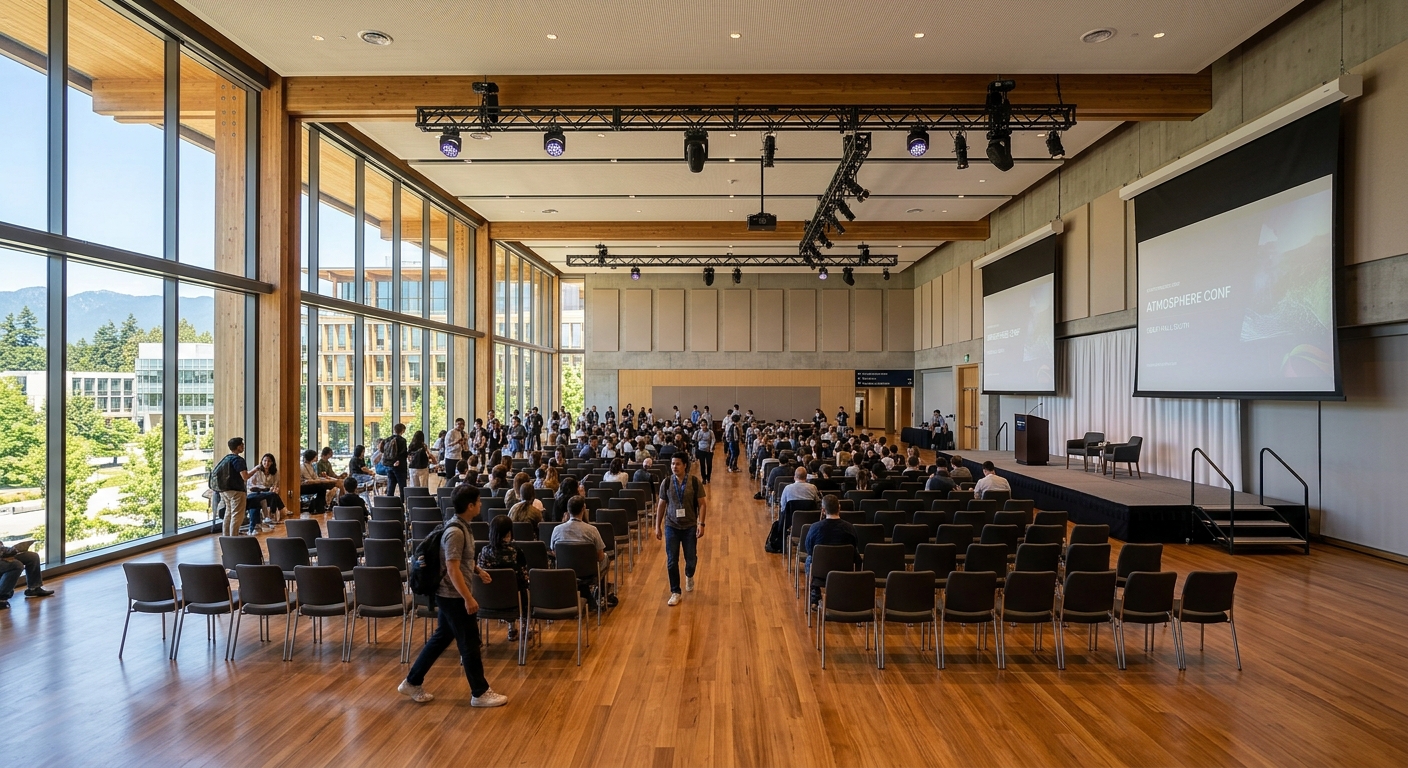
Opening Remarks Day 3
Notes on what’s happening to our ability to collectively know things, and a look ahead to what this community is especially well positioned to do to support and revitalize our info ecosystems and the humans inside them.

I had the privilege of discussing Blacksky and AT Protocol at several different college campuses, conference venues and other settings along with webinars and doing user research. I plan to share those learnings to help others build better products and how we particularly plan to incorporate those learnings from both a product and operations standpoint.

Traditional social platforms centralize control of community spaces—the platform owns your group, your members, and your data. On ATProto, ownership, governance, and moderation become explicit design decisions. This talk explores building shared resources on a decentralized protocol—from data synchronization to governance models—drawing from real experience building community features and examples from other ATProto apps.

Protocol architectures are governance structures. Their design choices allocate power, and what they leave unsaid gets filled by economics. This talk traces what happens when an open protocol's reach layer goes ungoverned, from SMTP to algorithmic convergence to why kpop fandoms are structurally destined to dominate engagement-driven systems.

Bluesky, a VC-backed company, runs public infrastructure that's widely depended upon by ATProto builders. Microcosm, a set of community-funded open-source infra, supports dozens of ATProto projects and growing. I'll dive into AT-protocol-specific economics of operating and scaling public infrastructure, and look ahead at how we get to a sustainable and diverse infra future. All grounded in the day-to-day reality of actually running big indexes, caches, relays, jetstreams, a PLC mirror, ...
![fig (aka:[phil]) avatar](https://cdn.bsky.app/img/avatar/plain/did:plc:hdhoaan3xa3jiuq4fg4mefid/bafkreiamovv77cuv63icyhvminjanb2dz4u6o5bjjzyk72ob44qtbrd224)
ATProtocol Identities and HTTP Signatures in conjunction with Onion Routing

How can we bring the open social web to millions more people? In 2 minutes, we'll show you how to curate content and create community that others can engage with from anywhere. Let's decentralize custom feeds and make them as easy to find and engage with as a website.

In this talk, Germ Network co-founder Tessa Brown asks us to center consent in our ongoing conversations about privacy, agency, and self-determination. She describes how Germ is built for consenting connections and shares the team’s learnings from integrating atproto handles into their end-to-end encrypted messenger. As we all onboard users familiar with centralized social media paradigms into the Atmosphere, Tessa reflects on the UX design choices Germ made to help users understand what they consent to when they bring their atproto identities into Germ.

What does it actually take to build and ship an AT Proto app? This panel features developers who have done exactly that using Expo. We'll cover the full journey: authentication and OAuth, working with decentralized identity, deploying to app stores, and scaling to real users. Whether you're exploring AT Proto for the first time or ready to start building, you'll walk away with practical insights from people who've shipped.


Paul Frazee, CTO of Bluesky, gives a report on the Atmosphere from Bluesky's point of view. New standards efforts, new protocol features, new developer tools and APIs - this year has it all. Paul will share what's going on, what Bluesky is working on, and why 2026 is going to be a great year for the Atmosphere. Paul will also be joined on stage by Chief Innovation Officer Jay Graber to talk about the future of building on atproto

The early web was full of trails: open paths that led to serendipitous discovery. Web2 platforms paved them over with superhighways built to extract your attention. Semble is bringing the trails back, turning everyday browsing into collective mapping, where every connection you make becomes a trail-marker that helps others navigate the open web. Built on atproto, because open trails belong on open, interoperable and collectively stewarded infrastructure.

In nine months, we grew Skylight Social from zero to over 350,000 downloads. This lightning talk distills the most important lessons from that journey; how to message open social to a broader audience, how to read user behavior over user requests, and which tools and collaborations actually scaled. It’s a practical look at what worked, what didn’t, and what I’d do again if I were starting today.

open source changed the world, but now it’s stuck in the age of pull requests and gatekeepers. what happens when you build it on a social protocol instead? (and complimentary to tangled) jeremie miller — creator of XMPP (the protocol behind whatsapp, zoom, and billions of daily messages) and bluesky board member — will demo something new built entirely on AT Protocol that reimagines how open source software gets discovered, shared, and trusted. this one’s going to break some brains.

My team at FSRI recently overhauled how all firefighters in the US report data with NERIS (https://neris.fsri.org/faqs). I want to share insights I gained into how centralization and the resulting enshittification has played out in fire software and how NERIS hasn’t fully solved the problem. I’d like to encourage more people to build fire (and other niche) software and create an open ecosystem of interoperable tools where fire department data ownership is at its heart and outline some opportunities and resources. If time permits I may very quickly reference similar initiatives like FHIR and open banking.

Phoenix Architecture is a way of thinking about software in a world where implementations can be rewritten faster than they can be understood. As AI shifts the economics from maintenance to regeneration, the real architectural questions move upstream: what must remain stable, what can safely change, and what breaks humans when it breaks at all. This talk offers a set of lenses (not answers) for reasoning about durability, trust, and coherence in long-lived systems. Attendees should leave with new instincts, sharper questions, and a sense that some of our deepest assumptions about software may need to be revisited.

From Software Engineering to Software Ecologies

Opening Remarks Day 4
We're building npmx in the open as a community project. Join us as we explore how we work together, how atproto has helped as connect, and how we have been adding social features to our website.


Building a company on an open protocol is a different ballgame. In this talk I aim to cover why we decided to make Tangled a company, how we're financed, why we went this route, the challenges we faced and our plans for the future.

I'll be sharing an abbreviated history of building Graze, our own product's theory of action and how it slots into our more broad theory of how the AT Protocol disrupts the existing social layer of the web. We'll move into successes and challenges with fundraising, what we learned during that process and what others should know. We'll wrap with our own theories on development in 2026, how we fully move beyond the "skeuomorph" era of ATProto.

The Future is not what you think. People trained on self driving cars or notions from the 1950s are ill-prepared to see what's actually growing behind the scenes, out of public view. It's not like anything on social media right now. It's in the cracks, almost imperceptible. Often it's the opposite of what's been said for years. We've stayed in this timeline for a long time. What will it take to get out of the 2010s?

Resonant Computing manifesto co-authors Mike Masnick (Bluesky board member, Techdirt) and Alex Komoroske (Common Tools) discuss why they felt compelled to articulate an alternative vision for computing—one that's private, plural, and prosocial. They'll explore what resonance actually means in practice, why the ATProto community is uniquely positioned to build this future, and talk about the infrastructure work to make it real.


What if social products were remixable?Imagine you could take a social product and break it its user interface into pieces. Then imagine that you, or anyone else, could recombine those pieces in different ways, swap things out, composing and remixing experiences made and hosted by different people.We already know a way to compose UI: Components. However, we didn't have a way to compose components across products. Atmosphere gives us that way: lexicons define component contracts, records point at the endpoints, everyone uses the same data.So let's put components on the protocol! In this talk, Dan will present Inlay—an experimental browser for remixable cross-product server-driven user interfaces on the Atmosphere. You can think of it as "React for atproto" or like "HyperCard for social".Whether it's a terrible idea or a glimpse of a post-app future remains to be seen.---(Demo teaser: https://bsky.app/profile/did:plc:fpruhuo22xkm5o7ttr2ktxdo/post/3mdjhy2bofk2h)

A panel with prominent designers/builders from the community to talk about design.

Game developers publish data across dozens of platforms they don't control... until payment processors or platform policies change the rules overnight. I'm building The Pentaract: both the lexicons and the management platform that let developers control their game data on ATProto, enabling true data sovereignty, player-owned achievements and saves, and decentralized modding systems. This talk breaks down how I'm using ATProto's distributed infrastructure to solve real industry problems, from scattered metadata to platform lock-in, and provides a blueprint for developers in any industry facing similar centralization challenges.

AT is entering a critical phase of maturation and becoming truly multi-stakeholder infrastructure. This talk covers the concrete steps both Bluesky and the AT ecosystem are taking to achieve "hard decentralization": forming an IETF working group to standardize the protocol, establishing independent governance for PLC, and implementing the technical foundations that make decentralization real - more and larger PDSes, seamless account portability, full network sync, and more.

A breakdown of improvements in multi-protocol services, including Bridgy Fed and Bounce, and where those services are going in 2026. Some things include: 1. Direct integrations with platforms + client tools 2. Moderation improvements 3. Working with other multi-protocol services 4. Major updates coming to Bridgy Fed

The AT Protocol introduces several affordances to social products which are unfamiliar to both product creators and users of social products. This presents a challenge in both imagining the new features and experiences made possible by the protocol and how to share those capabilities with users. I'll walk through a few of the unique powers of ATproto, what implications those have for how we build social products, and some thoughts on how to make it all make sense, and be compelling, for users.

ATProto is a great way to manage identity! One of my favorite things about it is that it's vendor-neutral. I'll describe how I used ATProto to build self-service licensing and analytics for a software beta with no third-party dependencies.

Connecting the "Wherever You Get Your Podcasts" blog I posted a ~month ago (https://knotbin.leaflet.pub/3lx3uqveyj22f) to interoperability in atproto.m using the podcast metaphor for feature adoption & how they're just one type of RSS feed, just like lexicons with records. In theory, apps can implement any lexicon. I'd then go into the actual experience of implementing this at the huge scale of Bluesky's lexicon and why Spark decided to take a different approach to lexicon interop in the end.

So far, many of the projects in the ATProtocol ecosystem have focused on bringing parity—making projects that replicate our existing tools and platforms, but with the affordances of the protocol instead. That's cool and we need to do that, but I think we can go much farther, and take this opportunity to challenge some of the biggest assumptions of what the modern internet is for, who builds it, and how we interact with it. This talk is in conversation with several of the talks from last year, and in I'll argue that we'll never get away from skeuomorphism until we've fundamentally changed the definition of what "the social internet" means in the first place.
