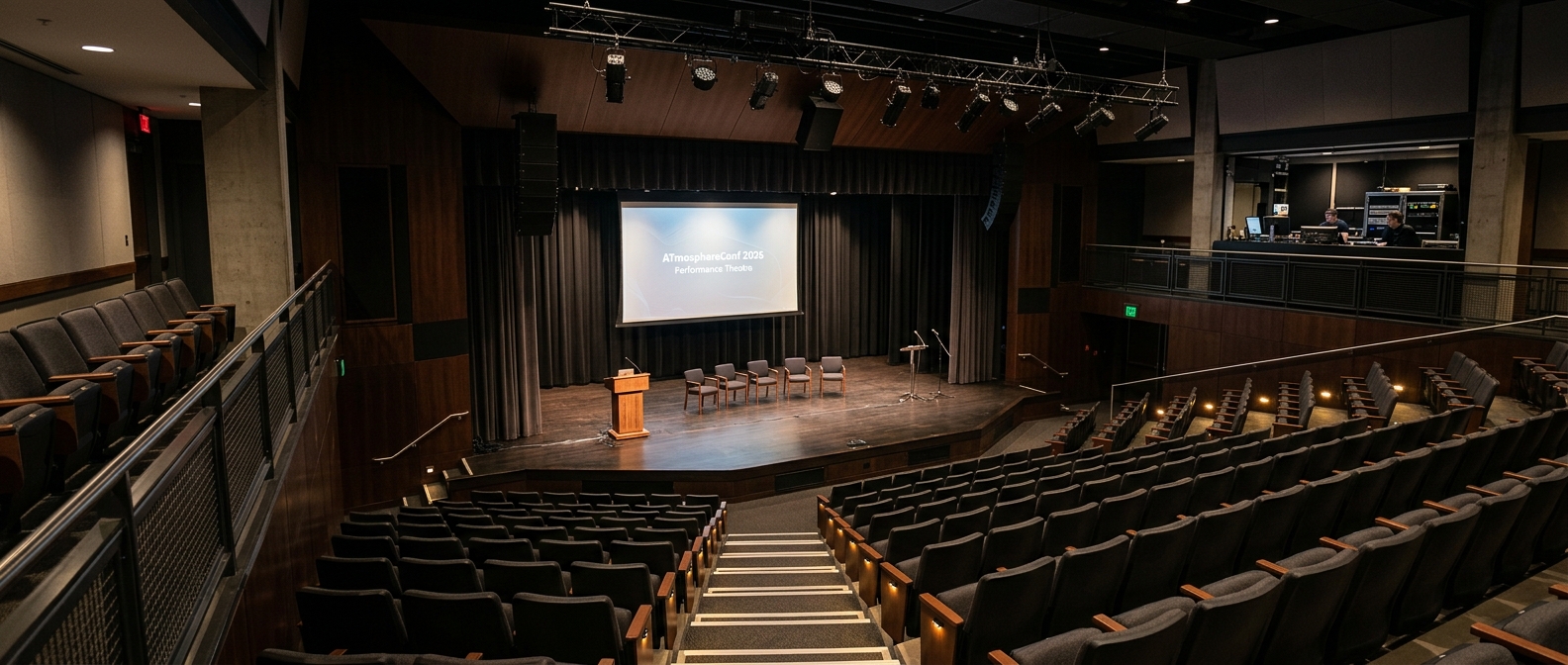
Attendees will play a game to navigate collapse of big tech and hospice existing social media, using practices of role play and DIY archiving to prepare for the transition to something new, drawing on de Oliveira Andreotti (2021). 90-minute session geared for people who have existing accounts on a platform or service they want to leave, especially Meta (Facebook, Instagram) or X. Attendees will have a richer experience if they have a device for some archiving activities but it is not required to attend the session. No technical experience required and open to all. Note: this activity is open to Vancouver attendees who are not attending the whole conference, in partnership with Our Networks https://ournetworks.ca/

In this workshop, we will ask: what are new social modalities that we can build with the affordances of ATProtocol? This is a cross-disciplinary workshop with people from all tracks to ideate and co-design together possibilities for new social and communal modes on the protocol (not focusing on implementation of ideas). Attendees will walk away with an expansion of future possibilities of what it looks like to be online.


Get feedback on your project and see what's growing! Recent talks about onboarding in the Atmosphere have drawn calls for more user research. This workshop from Germ's CEO Tessa Brown and founding engineer Anna Mistele is an opportunity for builders in the ecosystem to gain immediate insights by conducting research for their products, and for attendees to see new products in action. We're not experts, but rather fellow builders making space for us to learn from each other as a community! Supported by Tynan.


Opening remarks from the ATScience conference organizing team


The traditional scientific record ? anchored in static, monolithic PDFs and siloed journals ? is increasingly ill-equipped to handle the speed and complexity of modern discovery. This keynote explores a transition toward Modular Open Science: a future where research is a continuous, federated, and computable graph of knowledge.


We'll present Semble, a kind of "Spotify for research" enabling researchers to curate shareable collections, create knowledge trails that others can explore and extend, and discover relevant work shared with the network. Built on ATProto, Semble offers researchers data portability and an open API designed for extension. We'll discuss how Semble enables new kinds of research tooling, from living semantic citation graphs to collaborative review and annotation. We'll also share how Semble connects to Cosmik's broader work on collective intelligence, and opportunities for collaboration across the ATProto science ecosystem.
We will present Lea, a social app for researchers built on ATProto. Lea has many custom features for researchers, including 1. paper tracking, discovery, and discussion pages, 2. customized and verifiable profiles for researchers, 3. extensive safety and moderation features to keep discussions calm and productive. We'll discuss our goals, challenges, and open questions for Lea.

Chive is a decentralized preprint service featuring threaded review, formal endorsements, and a community-curated field taxonomy ? all as portable ATProto records users own. Chive provides a rich plugin interface, making it imminently extensible as the ATmosphere grows. It currently provides builtin plugins for integration with existing ATProto services, such as Semble, Leaflet, and WhiteWind.

ATProto is a core component of the coordination.network stack. We will share lessons learned from initiatives including: - direct nano-publishing from the lab bench, - hypothesis generation, - replicability prediction, - and automated progress reporting. The talk will hope to highlight pragmatic solutions we have found and to identify shared challenges we would love to address with the community.

Fragmentation is an endemic problem for scientific data, and it hinders our collective ability to both work with traditional methodologies, and to realize outside of the big labs the potential of AI-driven methods for science. In this talk, we'll see how atproto enables a step-change for the use of large-scale, distributed, open, interoperable scientific datasets.

BioKEA will demo a proof-of-concept automated reviewer for scientific papers. Provided with an arXiv ID or PDF, it extracts structured text, pulls context from Semantic Scholar and PubMed, and outputs a critical review flagging errors, missing context, and citation gaps. We'll run it live, preview some features, and discuss publishing review artifacts on ATProto.

Skysquare exists to make sense of the digital public square via Bluesky. Launching this summer as a Chrome extension, Skysquare overlays social media conversation onto the webpages people are discussing, allowing readers to experience our online conversation in richer context. When a page has been shared or talked about on Bluesky, Skysquare associates that discourse with the page itself and reveals the surrounding conversation directly in the browser. Instead of chasing links through feeds, readers and writers can immediately see who is talking about what in relation to the material they are reading, turning the web into a socially annotated layer of context. This talk will demonstrate the extension in action and explore how tools like Skysquare can help researchers, scientists, and educators connect conversations directly to the sources being discussed.

One of the biggest problems in society today is division driven by social / societal ills, information overload, and platforms that amplify echo chambers. In this talk we'll discuss how we're addressing all these problems at ViewSift through our new atproto social-research platform and teaching practical techniques to have healthy discussions around controversial topics that heal division.

Seams.so demo and live workshop

What's the point of doing science if you can't tell anyone about it? I'll present The Astrosky Ecosystem, a community project by astronomers to democratize social media access for the space science & space fan communities. I'll talk about our 30 months of running custom feeds, as well as our future plans to start PDS hosting and even venture towards an astrophotography appview.

We will discuss new advances in computing education. We will highlight projects that teach computing and data science at scale using Pyodide. We propose a new infrastructure model that builds on these advances and incorporates the ATmosphere as an identity model and content storage. Using ATmosphere services like Tangled and Blacksky, we can truly democratize computing education.

AMIA's vibrant Twitter backchannel fragmented post-X. This talk details our stalled effort to migrate the community to Bluesky. Despite a guide and conference launch, the "cold start" problem hindered adoption. I�ll share lessons learned, discuss migration barriers, and outline revised strategies to rebuild our clinical research network.

In this panel we will explore why, despite early momentum, the migration of researchers to Bluesky has waned. We will discuss better ways to onboard, retain, and attract researchers by highlighting the flexibility and extensibility of the AT Protocol. Panelists will share what's worked, what hasn't, and what a coordinated push to build a science ecosystem on Bluesky might look like.
Research synthesis, a desirable culmination of primary research, is notoriously slow, error-prone, and disconnected from the network of potential contributors. Now, ATProto offers a digital foundation upon which to recruit collaborators (Bluesky feeds), assign micro-tasks (discourse graphs), author reports (Leaflet) , and acknowledge contributions.

The ATProto ecosystem empowers novel social media research. Our research showcases three promising directions in this space: 1. Experiments on self-hosted feeds (Paper Skygest, findings and customization interface) 2. Experiments on existing feeds via collaboration with feed designers (collaboration with Graze Social and Aendra), 3. Observational analyses of social media (SAEs on AT Proto posts)

The Community Archive is a community-owned dataset of contributed Twitter data used to study how ideas spread in online communities. We developed methods to extract "narrative strands" ? coherent lines of discourse where ideas evolve and build on each other over time. These techniques generalize directly to atproto datasets and could help Bluesky communities understand their own emerging canons.

Presenting a working paper on the functional (de)centralization of Bluesky. This includes the extent to which AT Protocol infrastructure is owned by entities other than Bluesky Social (through mapping ownership of PDS endpoints) and the implications of this (de)centralization on Bluesky Social's goals. Following the presentation, there will be a Q&A and discussion!


Journalists are the sleeper agents to catalyze the protocol-based publishing revolution. They're already operating in federated ways -- they just don't use those words. Whether it’s a creator spackling together a media company from web pages and discords -- like so many Twitch streamers. Or journalists using newsletter products to build direct relationships with (and monetize) the massive massive scale audiences they reach through vertical video platforms and don't monetize ....They are federating in DIY ways just as more and more media companies get smaller and more and more journalists go independent. How do we harness this natural momentum towards an organized movement? How can technologists and content creators work together to work as a federated army of Pied Pipers to port audiences into the ATmosphere.

The talk will focus on (1) the structural shifts reshaping the media landscape & creator economy and provide a roadmap / suggestions for how the AT Protocol ecosystem & community can be best positioning to serve the needs of creators of all kinds (emphasis / focus here on independent creators) through this evolutio, while preserving their rights to sovereignty & ownership. The talk ideally touches on both cultural, economic and technical / infrastructural topics. Will be speaking in my capacity both as an artist and as an investor / student of media markets.

This panel spotlights creators on AT Protocol and the infrastructure that lets them own their audience and income. We will explore how video, music, reviews, and other media can interoperate across apps, helping artists reach fans anywhere without being tied to a single platform. Panelists will share emerging ways creators can earn, from direct fan support to premium content. Attendees will leave with a clear view of how ATProto can become the home for the next generation of creators.

Publishing changes as the internet has changed. We'll discuss the work of being news creators in this moment.


The concept of digital sovereignty has rapidly gained momentum in both Canada and Europe, reflecting growing concerns about who controls our digital infrastructure, data, and public discourse. Nowhere is this debate more dynamic than in the European Union, where lawmakers and advocacy organizations are actively shaping the future of the social web and the digital public sphere. As the founder of the Alliance of Open Networks and Democratic Public Spheres and a recent participant in the EU Summit on Digital Sovereignty, I will examine the communication strategies advocacy groups use to shape public discourse, build alliances, and engage with policymakers and the media. Attendees will understand how digital sovereignty is being debated in the EU, learn about the specific demands and advocacy tactics of European digital rights organizations, with a focus on open protocols, decentralized networks, and democratic governance. The goal of this talk is to identify opportunities for cross-border collaboration and knowledge exchange. In a year when digital policy is at the forefront of public debate, this talk offers timely, in-depth insights from the European experience, providing both inspiration and practical guidance for building a more open, decentralized, and democratic digital future.

The AT Protocol was developed as a decentralized alternative to big tech; it wasn’t envisioned as a response to authoritarian state power. Now, however, ATProto’s openness is also potentially a source of vulnerability. What are the potential threats, and how can they be countered? We’ll explore a brief history of networked authoritarianism, and consider options and strategies to manage ATProto in adversarial political environments.
Eurosky is a European initiative building shared ATProto infrastructure operated under EU law: PDS, relays, AppView capacity, and protocol-level moderation services. This talk explains why social media must be treated as critical infrastructure, how self-certifying data enables real separation of powers, and how a shared-cost moderation model lets independent developers comply with diverse legal regimes without central platform control.

A lightening talk showcasing Gander Social. Why we exist and how we interoperate.

We explain why this newest of AT-federation members has been created, how we believe social media can be made social again and what that means for the users and the business model. There will also be some hints about future plans.

Moving to a new social network is easy. Finding your people again is the hard part. This lightning talk introduces Sky Follower Bridge, a tool that helps users reconnect with their social graph on Bluesky. It also explores two technical challenges behind the project: extracting follow lists from browser pages and improving account matching across platforms.

Our working group (oaklog.org) is collaborating with local media publications, civic organizations, community leaders, and local venues to build a digital commons for event listings in the Oakland Bay Area. We'll share findings from our work co-designing with local information stewards and how we're exploring AT Protocol as a municipal utility that makes local data reliable, accessible, and reusable across organizations and tools.

Proprietary social media platforms intermediate the two main things journalism needs to survive: attention and revenue. Drawing from our combined experience building tech for newsrooms from the Chicago Tribune to ProPublica, we'll explore how building on protocols, not platforms could create a media environment where both publishers and audiences control their own destiny. Two veteran news/open social web nerds have ideas about what this could look like in practice (and want to hear yours!)


There is now an abundance of evidence that corporate social media owners are putting their thumb on the algorithmic scale. Between increasing the visibility of far-right viewpoints, shadowbanning content with external links, and the disintermediation of media orgs through AI-based summary results, it is an incredibly challenging time to be in the news business. There is one bright spot, however: ATProto. Join Aendra Rininsland, creator of the News and Trending News feeds, as she discusses why it's not just possible for the media industry to create its own algorithms for news content, but also profoundly necessary for the future of quality journalism.

For decades, news organizations have chased audiences on proprietary social platforms where they have no control over how their content is delivered. The ATProtocol offers a chance for news organizations to start fresh and participate as first-class citizens in the open social web. In this panel, we will discuss strategies for getting started on ATProto as a news organization and the potential benefits of moving early.

I will make the case that DID:PLC forks will inevitably emerge as the wider atproto ecosystem keeps gaining global relevance: pressure on the governance model of the identity system will increase to a point where conflicts (e.g. over which DID suspension requests should be honored and which should be ignored) cannot be easilly resolved within a ‘permissioned consortium’ (as proposed in https://atproto.com/guides/identity) anymore. It seems evident that we can only argue about WHEN this will happen, not IF it will happen. In order to be able to maintain coherent UI experiences (without threads looking more and more broken due to different forks being used in different appviews) it seems necessary to extend the adversarial design patterns at the heart of the bluesky project (‘the company is the future adversary’) to the governance model of the underlying DID:PLC identity system: ‘the consortium will become target of future adversaries’. Can permissionless observatory networks help? Can we avoid using cryptoeconomics? What other options seem useful? During this presentation, I will present the results of my ongoing PhD research project on these questions. --- About me: I'm part of a small team (including Marcus Sabadello, co-author and editor of the DID specification) that started to advocate for the adoption of DIDs within ActivityPub networks back in 2018 (predating Jay Graber’s ecosystem review and the birth of the bluesky project). https://github.com/WebOfTrustInfo/rwot9-prague/blob/master/topics-and-advance-readings/fediverse-did-integration.md https://chaos.social/@cypherhippie/102270069807129706 Link to a (somewhat cringe) video for a grant application in 2018: https://youtu.be/UJn7cLNh_q8?t=85 Recent talk at fediday berlin: Protocol Convergence within Open Science Communication Networks https://fair.tube/w/p/2PEFZ5cdptsVASU4HTUakA Upcoming presentation at fosdem: Increasing Long Term Stability of Relations Between Fediverse Identities using SSI https://fosdem.org/2026/schedule/event/RZRZ9P-increasing_long_term_stability_of_relations_between_fediverse_identities_using_s/

I'll briefly demonstrate Bluenotes, a fork of the Bluesky with Community Notes. Then I'll discuss a proposed "Open Community Notes" standard and lexicon for Community Notes on ATProto, and discuss challenges such as preserving contributor anonymity and defending against manipulation.

How we can build a community that is on ATproto with content that can be contained to users within their community boundary, a form of privacy without forcing us completely off the protocol. Rather than focusing on how to handle private data with the dimensions of access we will implement a design that functions at the appview allowing any client to see it.

Products no longer need to steal another killer feature that's on another app, they can just share it! This presentation will go through a product I'm working on that uses lexicons to integrate bidirectionally with a few other applications on the protocol. Future considerations could involve collaborative UI components for a lexicon.

With a renewed push in the AI field toward smaller, distilled models, the community outside the Big Labs™️ has greater and greater power to shape AI's future. @maxine.science will share a story of how Forecast Bio is building tools on atproto for (1) distributed, structured, streamable AI training data, and (2) a full phylogeny of model weights and evals across different training paths. Attendees will see how open infra built on atproto can put the frontier of AI back in the community's hands.
The AT Protocol guarantees sovereignty to the user. But it does not yet do the same for communities. Community stewards, like platforms, become landlords by necessity. Can we address this from the protocol up? In this presentation, I’ll use furryli.st, which defines and serves a community of 60,000+ furries on the AT Protocol, as a case study to deconstruct the "community" into distinct roles and relationships, identify existing protocol-native analogues, and propose what needs to be built next to create resilient, protocol-native communities defined by *people*, rather than infrastructure.

Over the course of 12 months, I created a dozen ATmosphere based projects, apps, and experiences ranging from a decentralized toilet to a client interface named after a moth. Collectively these projects amassed 100,000 unique visitors and over half a million page views. Each project took me deeper and deeper into the world of the AT Protocol and showed me what the future of social media might look like... and what it could take to get there. Over the course of this presentation I will share the lessons I learned and what I think it means for the future of social media.

This talk will go into depth on the design philosophy that underpins my project BookHive, a book tracking application comparable to Goodreads. The main point is a call to action that we should give users' agency over their data, by aiming to make the data that we store in their PDS as interoperable as possible. This means more than just recording IDs in their PDS, actually giving them the data that you use to construct your application. https://nick-the-sick.pckt.blog/the-design-philosophy-of-bookhive-s23cz85

Quick dive into AppViews. Talk about what an AppView is/does, explore different implementations/setups, and show how tools like quickslice can abstract that all away allowing you to focus on your lexicons and UI/UX.

When developing applications, there are a lot of client technologies that can talk to server backends. ATProto is extensible, federated, and works with backend data stores; GraphQL is often fixed for a specific application, precompiled, and yet performs a somewhat similar function. Because GraphQL tooling is common for application development (e.g. Relay, Apollo) it would make sense to bridge these two technologies so developers can bootstrap ATProto applications with widely available tools. My talk would explain my deep dive into this (starting with an Expo App) and some thoughts about how this would scale to introduce more developers into the ATmosphere.

A talk about spite-driven development and the process of using a language with a reputation for difficulty to make atproto development approachable. How do we encode the constraints (and freedoms) of the protocol in a way that makes sense and doesn't impose undue friction? What are good things to have in the defaults? There is not one right answer, and the answer, as well as the points of freedom to choose a different answer for yourself, matters. What can that ethos and its result allow you to do which you might not expect is possible?

Sharing visions about how artists could thrive in the ATProto ecosystem: 1. building community and inspiration in different paces, with an artist curated app, from microvisuals, microblogging to book clubs and music shows. 2. financial sustainability: a proposal for artist owned music distribution and licensing from the PDS 3. creativity: redefining composition techniques with ATProto technology
